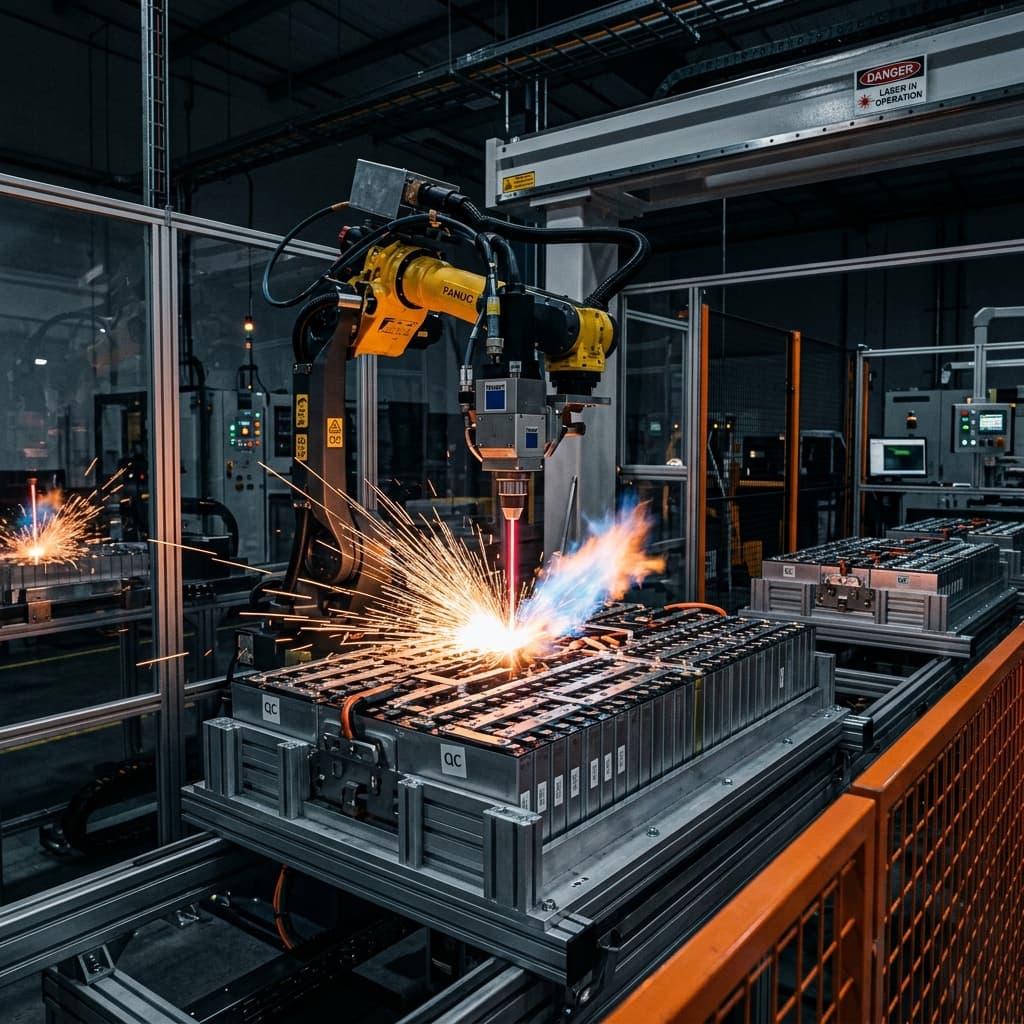
Our laser welding operation joins cells and modules into finished battery packs with the precision and repeatability that EV and energy storage applications demand. It's the final stage of our loop — the point at which recovered, refined, and plated materials re-enter service as a finished product.
Why Laser Welding
Laser welding is the manufacturing process of choice for high-volume battery pack assembly. It produces clean, narrow, low-heat-affected-zone welds that are critical for battery safety and longevity. Unlike resistance welding or ultrasonic bonding, laser welding can join dissimilar metals (copper to aluminium, for example) without the intermetallic formation that compromises joint integrity.
Our Capability
We run precision laser welding for cell-to-cell joining, cell-to-busbar welding, module assembly, and pack integration. We work with both cylindrical and prismatic cell formats. Our system is configured for the typical current collector materials used in modern lithium-ion battery packs — copper anodes and aluminium cathodes — as well as nickel-coated contacts.
Quality Assurance
Weld quality is verified through pull-force testing, visual inspection, and electrical resistance measurement. We maintain process data for every weld batch, including laser parameters, weld geometry, and QC results — providing full traceability for customers requiring documentation for their own quality systems.