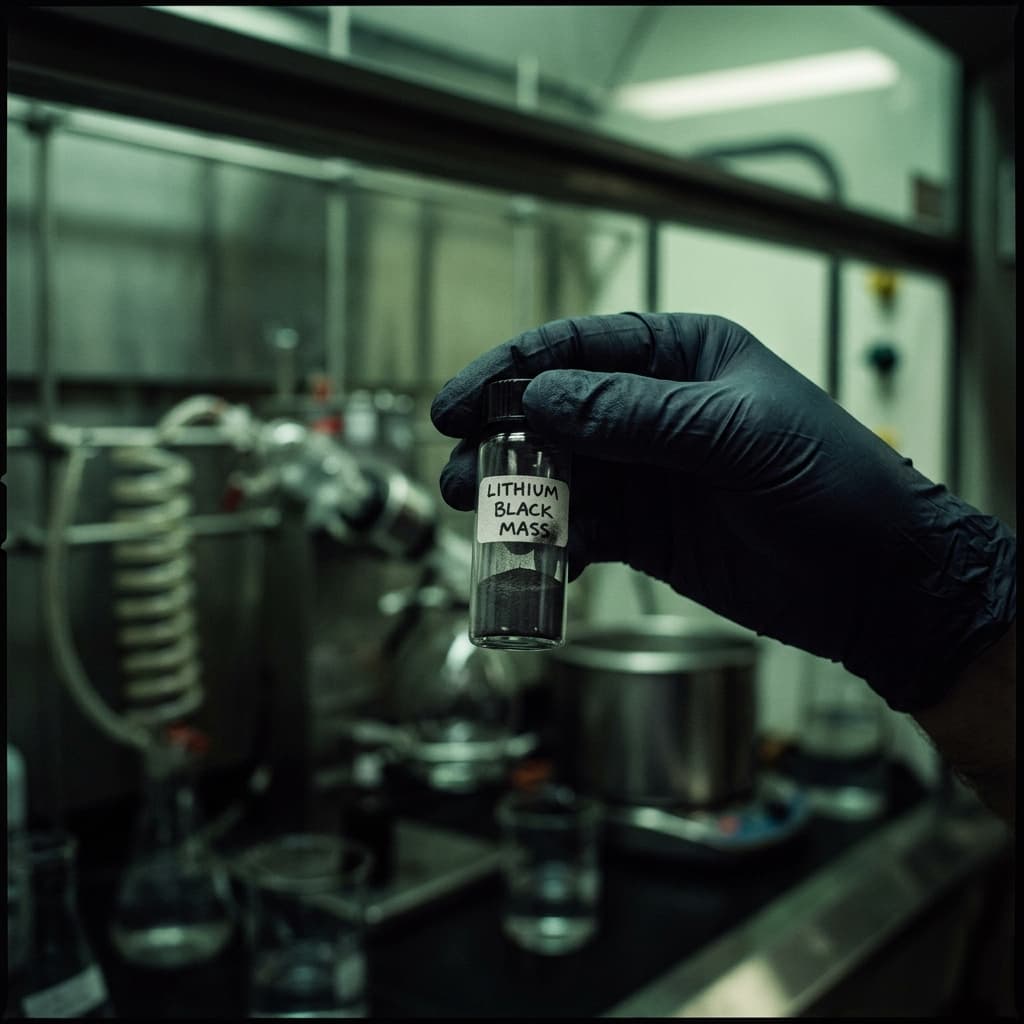
If you follow battery recycling, you'll hear the term "black mass" constantly. It's become a shorthand for the entire recycling industry — but the specifics of what black mass actually is, how it's produced, and why it varies so dramatically in quality are less often explained.
This post breaks it down.
What Is Black Mass?
Black mass is the dark, powdery material recovered after lithium-ion battery cells are mechanically processed — typically shredded, separated, and dried. The name comes from its colour: a mixture of graphite (black), cathode metal oxides, and residual carbon.
A typical black mass sample contains:
| Component | Approximate range | |-----------|------------------| | Graphite | 20–35% | | Lithium | 3–7% | | Cobalt | 5–20% (NMC/LCO chemistries) | | Nickel | 5–25% (NMC/NCA chemistries) | | Manganese | 3–15% (NMC chemistries) | | Copper | 3–8% | | Aluminium | 1–5% |
The exact composition depends heavily on the cell chemistry being processed — LFP (lithium iron phosphate) batteries produce black mass with negligible cobalt, while NMC (nickel manganese cobalt) cells produce a much richer cathode metal mix.
How Black Mass Is Produced
The general process for producing black mass from end-of-life batteries:
1. Collection and Sorting
Batteries arrive as packs, modules, or individual cells. They need to be sorted by chemistry (LFP vs. NMC vs. NCA) because mixing chemistries degrades downstream recovery value.
2. Discharge
Cells must be fully discharged before processing — residual charge creates fire and explosion risk during shredding. This is typically done by salt-water immersion, resistive load, or cryogenic treatment.
3. Mechanical Processing
Cells are shredded in an inert atmosphere (nitrogen blanket) to prevent lithium reactions with moisture or oxygen. The shredded material is then separated: steel casings, copper/aluminium current collectors, and the electrode powder fraction (the black mass itself) are separated by sieving and density separation.
4. Thermal Treatment
Black mass often undergoes a pyrolysis or calcination step to burn off organic binders (PVDF) and electrolyte solvents, improving the purity of the cathode and anode fractions.
Why Black Mass Quality Varies Enormously
Not all black mass is equal. The variables that determine quality:
Cell chemistry sorting: Mixed chemistry black mass is worth significantly less. NMC black mass commands a premium because of its cobalt and nickel content; LFP black mass requires different downstream processing.
Discharge completeness: Inadequately discharged cells increase risk and can result in lithium loss during shredding.
Atmospheric control: Processing in open air (without nitrogen blanket) causes lithium oxidation and moisture absorption, degrading the active material before it even reaches the refining stage.
Binder removal: Incomplete binder removal means downstream hydrometallurgy has to deal with organic contaminants, reducing efficiency and yield.
Moisture content: Black mass must be dried adequately — excessive moisture complicates downstream processing and affects accurate assay.
From Black Mass to Battery-Grade Materials
Black mass is an intermediate, not a final product. The two main routes from black mass to battery-grade materials:
Hydrometallurgy (wet chemistry)
The dominant commercial approach: black mass is dissolved in acid, followed by selective precipitation and solvent extraction to recover individual metals. It's proven and produces high-purity outputs — but it's capital-intensive and generates acid waste streams that require treatment.
Direct Recycling
The approach Renovar uses: instead of dissolving the cathode material back to its constituent metals, direct recycling regenerates the cathode structure itself. This is more energy-efficient, preserves the crystal structure of the cathode active material, and — when done correctly — produces cathode active material (CAM) that is directly usable by cell manufacturers.
Our patented process, validated by CECRI (the Central Electrochemical Research Institute), is the first of its kind in India to demonstrate battery-grade CAM from domestic black mass.
Why This Matters for Supply Chains
India's battery manufacturers currently import virtually all their cathode active material — from China, Japan, South Korea, and Belgium. The economics of this import dependency compound the underlying geopolitical risk.
Black mass recovered domestically, processed to battery-grade CAM domestically, means:
- Shorter lead times — weeks, not months
- Lower FX risk — INR-denominated inputs
- Supply security — independent of export controls in producing countries
- Traceability — domestic chain of custody from scrap to cell
The infrastructure to make that supply chain real starts with black mass recovery. Everything downstream — CAM production, electroplating, pack assembly — depends on the quality of what comes out of that first stage.
That's why, at Renovar, the black mass recovery operation is the foundational process the rest of the loop is built on.