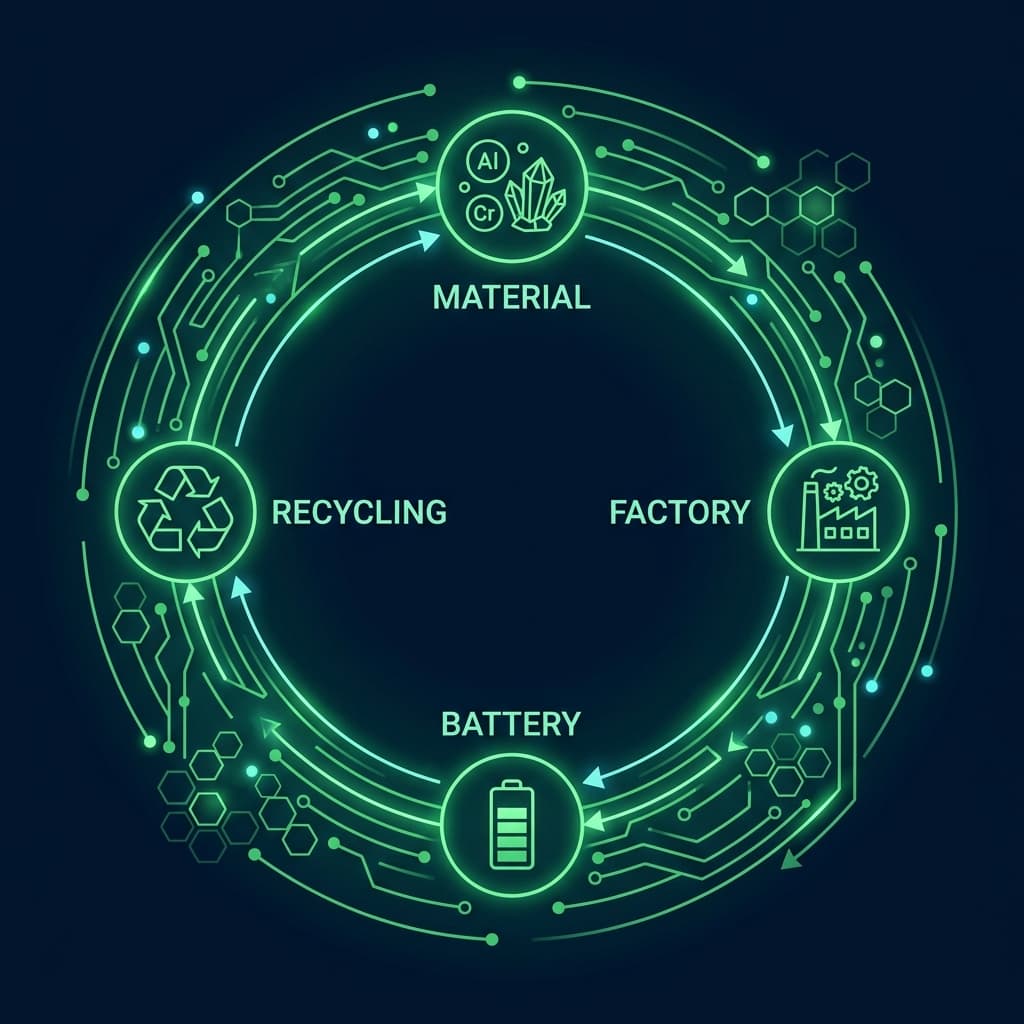
India's EV adoption story is well-told. Two-wheelers hitting monthly sales records. Battery storage projects sprouting across states. Policy frameworks stacking up — the PLI scheme, the FAME subsidies, the NITI Aayog roadmaps. The supply side is being built.
What nobody's talking about nearly enough is the other end.
The Volumes Are Coming, Ready or Not
A lithium-ion battery cell has a usable life of roughly 8–10 years in a vehicle application, or 5–7 under heavy duty-cycle conditions. The EV fleet India is deploying today will begin retiring its first generation of cells between 2028 and 2032.
The numbers aren't small. If India reaches even a fraction of its stated EV targets, the annual end-of-life battery volume by 2030 will be measured in thousands of tonnes of battery scrap — predominantly lithium, cobalt, nickel, manganese, and graphite locked inside cells that have nowhere to go.
Without a domestic recycling infrastructure, that material either goes into informal channels (hazardous, low-recovery) or leaves the country as raw scrap to be processed elsewhere.
Both outcomes export value India doesn't need to give away.
Why "Critical Minerals" Isn't Just a Policy Phrase
India imports approximately 70% of its cobalt and nearly all of its lithium. These aren't commodities with easy substitutes — they're the inputs that battery manufacturers, both global and domestic, cannot make cells without.
The logic of circular economy for batteries isn't just environmental. It's a supply chain argument. Every tonne of cathode active material recovered from domestic scrap is a tonne that doesn't need to be sourced from the DRC, or Australia, or Chile — subject to geopolitical risk, FX exposure, and lead times.
The Atmanirbhar Bharat vision, in battery terms, runs directly through recycling infrastructure.
Where the Gap Actually Is
Most coverage of battery recycling focuses on the chemistry and the policy. The operational gap is less discussed: the physical infrastructure to collect, sort, discharge, and process battery scrap into a form that can re-enter the supply chain.
Black mass — the powder recovered after cells are shredded and processed — is the critical intermediate. From black mass, you can extract:
- Graphite (anode material, mostly imported from China today)
- Lithium carbonate / hydroxide (cathode precursor)
- Cobalt, nickel, manganese (the NMC/NCA cathode metals)
- Copper and aluminium (current collector foils)
Getting from battery scrap to black mass requires the right equipment, the right safety protocols, and — critically — a validated process that buyers will trust. That last part is where most operations fail commercially even if they succeed technically.
What Renovar Is Building
Renovar's approach is to close the loop at the material level, not just the recycling level. That means:
- Black mass recovery at our plant in SIDCO Thirumazhisai, Chennai
- Direct recycling to cathode active material (CAM) via our patented, CECRI-validated process — the most technically complex and highest-value step
- Renovite nickel plating to finish battery components to spec
- Laser welding for pack assembly — so recovered materials re-enter the supply chain as finished components, not commodities
The full loop. In one location. Validated by India's premier electrochemical research institution.
The Window Is Now
Infrastructure takes time. The recycling plants that will process India's 2030 battery scrap volume need to be built, validated, and scaled in the years before those volumes arrive — not after.
The companies and investors who recognise this aren't just making a sustainability bet. They're positioning for the moment India's battery supply chain has to go circular by volume, not by choice.
That moment is closer than the headlines suggest.