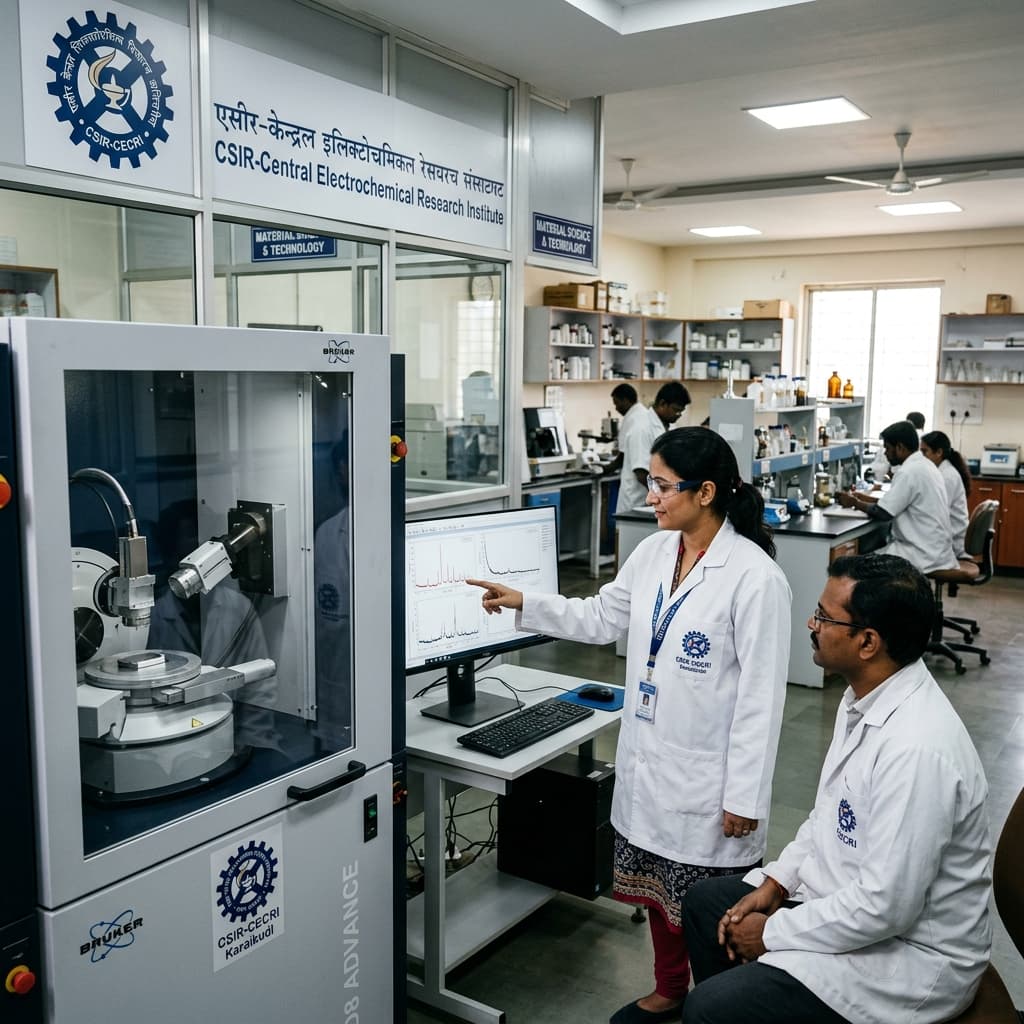
When we say our direct recycling process is "CECRI-validated," we're not invoking that phrase as marketing. We mean something specific — and it's worth explaining what it actually means, how the validation works, and why it matters to the people evaluating our process: cell manufacturers, battery pack makers, investors, and lenders.
What CECRI Is
The Central Electrochemical Research Institute is India's premier government research institution in electrochemistry. It operates under the Council of Scientific and Industrial Research (CSIR) and has been the backbone of India's electrochemical R&D for over 70 years. It's where India's battery research happens at the materials level.
CECRI is based in Karaikudi, Tamil Nadu — and it's the institution you go to when you need a claim about electrochemical process performance to be independently verified with scientific rigour.
What Getting Validated Actually Involves
The validation process for our CAM (cathode active material) production is not a single test or a certificate-of-completion. It's a structured series of characterisation studies on the output material — verifying that what we produce from black mass actually performs at battery-grade specification.
The tests our process outputs went through include:
Structural characterisation
- X-ray diffraction (XRD) to confirm the crystal structure of the recovered cathode material matches virgin material
- Scanning electron microscopy (SEM) to verify particle morphology and size distribution
Chemical composition
- Inductively coupled plasma (ICP) spectroscopy for metal content and impurity levels
- Thermogravimetric analysis (TGA) for organic residue
Electrochemical performance
- Half-cell and full-cell cycling to verify discharge capacity, rate capability, and cycle life
- Comparing recovered CAM against commercial reference material
The critical outputs: cycle life retention, specific capacity, and rate performance of cells made with recovered CAM versus cells made with virgin imported material.
What the Results Showed
We're not going to share the full technical dataset publicly, but the headline result: our CAM passed the electrochemical performance benchmarks that CECRI applies to battery-grade material.
The recovered material demonstrated specific capacity and cycle retention comparable to commercially available imported cathode active material.
That means a cell manufacturer can use Renovar-supplied CAM in the same way they use imported material — without redesigning cell chemistry or accepting a performance penalty.
Why This Matters Commercially
The technical validation answers the first question any serious buyer asks: Does it work?
But the who behind the validation answers the second question: Should I believe the claim?
India's battery supply chain is deeply import-dependent. Cell manufacturers have qualified their processes around imported material from a small number of very established suppliers — Umicore, Sumitomo, CNGR, and a handful of others. Switching to a domestic supplier — even a cheaper or faster one — is a qualification risk.
CECRI validation provides something those manufacturers need before they'll consider qualification: an independent, government-backed technical stamp that says the material meets specification. It's not just a report from the company trying to sell them the material.
For lenders and investors, the CECRI validation provides independent evidence that the process isn't just a claim. Infrastructure-stage battery recycling businesses are evaluated on process certainty as much as market opportunity — the question isn't just whether batteries will need recycling (they will) but whether this specific process will produce material that buyers will actually purchase.
The Bigger Picture: India's Validation Infrastructure
There's a less-discussed point here. India has been trying to build a domestic battery supply chain — cells, packs, and increasingly materials. One of the underdiscussed gaps is validation infrastructure: independent testing and certification capacity for battery materials.
CECRI's ability to run this validation for our process is itself a signal that India's scientific institutions are capable of supporting a domestic materials supply chain, not just conducting research about it.
As India's battery industry scales, the ability to independently validate domestically-produced materials — instead of relying on foreign lab certifications — will matter more and more.
Renovar's CECRI validation is, in some small way, a proof of that infrastructure too.
What's Next
Validation is a starting point, not a destination. The next milestone is commercial-scale demonstration: producing CAM at volumes that cell manufacturers can run qualification batches with, in timelines that fit their procurement cycles.
We're building toward that. The plant at SIDCO Thirumazhisai is our foundation. The CECRI validation is the credential that gets us the right conversations with the right buyers.
The rest is execution.